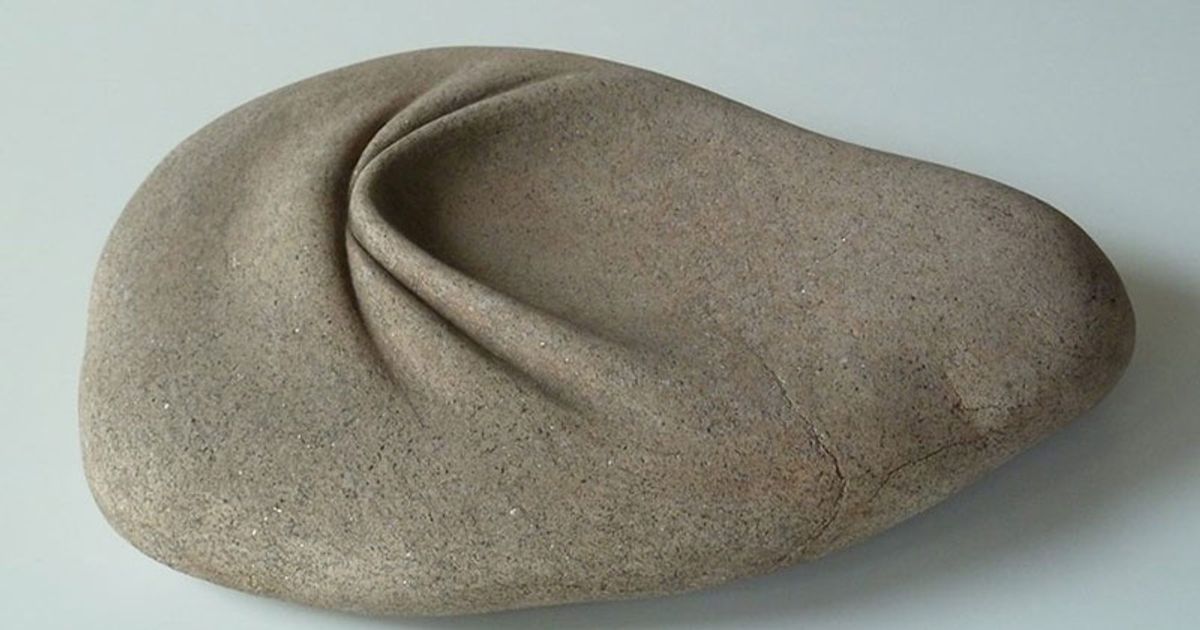
What if the hardest materials in nature could feel soft to the touch? What if granite whispered secrets and quartz surrendered to an artist’s vision like clay in a potter’s hands?
These aren’t the fantasies of a dreamer, but the lived reality of José Manuel Castro López, a Spanish sculptor who has spent decades convincing stone that it doesn’t have to be rigid. His remarkable body of work transforms one of Earth’s most unyielding substances into something that appears almost pliable, almost willing to bend.
The Man Who Speaks to Stone
In a modest studio nestled in rural Spain, José Manuel Castro López approaches his craft with the reverence of someone entering sacred ground. He doesn’t see himself as a traditional sculptor wielding tools to impose his will on stone. Instead, he describes himself as a druid—a spiritual intermediary between the natural world and human imagination.
This philosophical approach fundamentally shapes everything he creates. Before his chisel touches quartz or granite, Castro López spends time with the material, observing its grain, its color variations, its unique character. He believes every stone contains an inherent potential, a dormant form waiting to be awakened.
His studio walls are lined with blocks of stone in various stages of transformation, each one a conversation between artist and material that unfolds across months or even years. Unlike sculptors who sketch detailed plans before beginning, Castro López allows inspiration to guide his hand during the carving process itself.
“I don’t impose my ideas onto the stone. The stone and I collaborate. I listen more than I speak,” Castro López has explained in interviews about his creative process. This philosophy represents a departure from conventional sculptural traditions that emphasize predetermined design and execution.
The Illusion of Softness in Solid Matter
The most striking characteristic of Castro López’s sculptures is their paradoxical appearance. Granite and quartz, among the hardest naturally occurring materials on Earth, emerge from his workshop appearing soft, malleable, and almost yielding. His hands seem to have kneaded these stones like bread dough.
This optical illusion stems from masterful technique combined with a deep understanding of light and shadow. By carving gentle undulations, subtle folds, and flowing curves into the stone’s surface, Castro López creates the visual impression that the material has been squeezed, pinched, and molded. Viewers often find themselves wanting to touch the sculptures to confirm they are indeed solid rock.
The technical skill required to achieve this effect cannot be overstated. Each curve must be calculated precisely, each transition from light to shadow carefully considered. A single misplaced blow from a chisel can ruin weeks of work, yet Castro López executes these delicate operations with the focus and precision of a surgeon.
Photography of his work presents its own challenge. The sculptures seem to shift their appearance depending on lighting conditions, angles, and time of day. What appears soft in morning light might seem entirely different under afternoon sun, as shadows dance across the kneaded surfaces.
| Stone Type | Hardness (Mohs Scale) | Common Uses in Castro López’s Work | Carving Difficulty |
|---|---|---|---|
| Granite | 6-7 | Large-scale installations, public pieces | Very High |
| Quartz | 7 | Intimate sculptures, detailed work | Very High |
| Marble | 3-4 | Rare, specialized commissions | High |
| Slate | 2-3 | Experimental pieces, student work | Moderate |
A Journey Without a Predetermined Map
Castro López’s creative methodology stands in stark contrast to the systematic approaches taught in most art academies. Traditional sculptors typically complete detailed sketches, create scale models, and plan every aspect of the final work before touching the primary material. This methodical approach minimizes waste and ensures predictable results.
- ➡17 Moments That Prove Kindness and Compassion Are Always Worth It, Even When It’s Hard
- ➡12 People Who Are Fluent in the Language of Kindness and Changed a Life
- ➡15 Generosity Moments That Prove Money Means Most When It Comes From the Heart
- ➡12 Real Moments Where People Prove Compassion and Empathy Are the Secrets to Happiness
Castro López abandons this framework entirely. He begins with a block of stone and allows the carving process itself to generate ideas. If the stone’s hidden grain suggests a particular form, he follows that suggestion. If his hands discover an unexpected curve or fold, he integrates it into his vision.
This intuitive method carries significant risk. Materials are expensive, time commitments are substantial, and there is no guarantee of success. Yet Castro López accepts these risks as fundamental to authentic artistic creation. He views mistakes and unexpected developments not as failures but as invitations to discover new possibilities.
“The best ideas never come from my mind before I start working. They emerge from the stone itself, from the process of discovery,” Castro López noted during a 2019 retrospective exhibition. “Planning everything in advance would be like writing the ending of a story before understanding the characters.”
This approach has influenced a generation of younger sculptors who are increasingly questioning whether complete pre-planning actually serves artistic innovation or simply provides comfort to artists fearful of the unknown.
Technical Mastery Meets Spiritual Connection
The apparent contradiction between Castro López’s spiritual philosophy and the concrete technical demands of his work actually represents a unified vision. He achieves remarkable results precisely because he combines rigorous skill development with openness to intuitive guidance.
His hands have been trained through decades of practice to understand how stone responds to different tools, applied at various angles, with differing levels of force. This embodied knowledge allows him to execute complex maneuvers almost automatically, freeing his conscious mind to focus on artistic vision and creative inspiration.
Physical stamina also plays an underappreciated role in Castro López’s practice. Carving granite and quartz demands sustained physical effort, often performed in uncomfortable positions. His body has adapted to this demanding work through years of conditioning, allowing him to maintain precision even when fatigued.
| Tool Type | Primary Function | Skill Level Required | Typical Use Cases |
|---|---|---|---|
| Point Chisel | Initial roughing and bulk removal | Intermediate | Early carving stages |
| Flat Chisel | Creating defined surfaces and edges | Advanced | Mid-stage refinement |
| Tooth Chisel | Creating texture and detailed marks | Expert | Final surface articulation |
| Rounded Chisel | Producing soft curves and flowing lines | Expert | Creating the illusion of softness |
| Pneumatic Tools | Powered carving for larger areas | Advanced | Accelerating bulk removal |
- ➡11 Moments That Prove Kind Coworkers Are the Reason People Survive Office Life
- ➡13 Moments That Remind Us Kindness Is Still Alive Even When the World Turns Away
- ➡12 Moments That Show How Compassion and Kindness Turn Strangers Into Family
- ➡10 Moments That Prove Quiet Kindness Shines Light Even When the World Turns Dark
International Recognition and Contemporary Influence
Though Castro López maintained a relatively low profile for much of his career, focusing on his craft rather than self-promotion, international art institutions have increasingly sought his work in recent decades. Major museums have acquired pieces for their permanent collections, and his sculptures appear in public spaces across Europe.
Contemporary critics often position his work within broader movements questioning the relationship between artists and materials in the modern era. As industrial processes and digital fabrication become increasingly dominant, Castro López represents a counterpoint—an artist who insists on direct, unmediated engagement with natural materials.
His influence extends beyond sculpture into broader artistic discourse about authenticity, intuition, and the role of accident and surprise in creative work. Young artists across multiple disciplines cite his approach as inspirational, particularly those skeptical of overly conceptual or theoretically mediated art practices.
“Castro López demonstrates that traditional craft skills, far from being anachronistic, can express profoundly contemporary concerns,” wrote contemporary art theorist María Rodríguez in a 2021 catalog essay. “His work reminds us that engaging directly with materials remains one of the most powerful forms of human expression available to artists.”
Also Read
- ➡Selena Gomez’s ‘Lizzie McGuire’ and ‘Suite Life’ Spinoffs Got Dumped: “I Was at My Wits’ End”
- ➡I Saved for a New Car, but My Mom Thought She Needed the Money More
- ➡8 Seriously Emotional Photos That Will Melt Your Heart
- ➡11 Stories That Prove Kindness Hits Harder Than Anything This Cruel World Throws at Us
The Physical Transformation of Material Consciousness
One of the most fascinating aspects of Castro López’s practice involves what might be called the transformation of how viewers perceive material reality. Encountering one of his sculptures often produces a cognitive shift—our expectations about stone’s properties seem momentarily suspended.
This perceptual transformation has psychological dimensions worth exploring. Viewers approaching a Castro López sculpture expecting to encounter cold, hard, unyielding granite instead find themselves confronted with apparent softness and malleability. This contradiction between expectation and sensory experience creates a productive cognitive disruption.
Some viewers report an almost unsettling experience, as though fundamental assumptions about the physical world have been questioned. Others describe a sense of wonder or delight at the artist’s apparent ability to negotiate with nature itself. These varied responses suggest that Castro López’s work operates at multiple levels simultaneously—technical, aesthetic, and philosophical.
The tactile dimension remains crucial even when viewers don’t actually touch the sculptures. The visual suggestion of softness triggers phantom tactile sensations, as our brains imagine how the stone might feel if we were to run our hands across its kneaded surface.
Studio Practice and Daily Ritual
Castro López’s studio operates according to rhythms quite different from typical contemporary art spaces. Rather than following market demands or curatorial deadlines, he structures his time around the natural cycles of stone and season. Winter months often involve preliminary work and planning, while spring and summer enable sustained engagement with larger projects.
His working day typically begins before dawn, allowing him to work during early morning hours when light is soft and his mind feels most receptive to intuitive guidance. He works in extended sessions, sometimes carving for eight or ten hours without interruption, believing that sustained focus allows him to achieve the meditative state necessary for his best work.
The studio itself functions almost like a monastery or ashram. Visitors report an atmosphere of profound quietude, punctuated only by the sounds of tools meeting stone. Castro López speaks rarely while working, and his assistants learn to move through the space with minimal disruption.
“Working in the studio with Castro López taught me that silence isn’t empty—it’s full of communication between artist and material,” recalled one of his former apprentices. “You learn to listen to the stone, to understand what it wants to become. It’s less like making art and more like midwifery.”
Legacy and Future Trajectories
As Castro López enters his later years, questions naturally arise about the transmission of his knowledge and the continuation of his approach. Unlike art forms that can be easily documented through notation or instruction, the kind of sculptural mastery he has developed seems to resist systematization.
He has taken on several apprentices over the years, though he maintains that the apprenticeship model remains the only viable means of transmitting this knowledge. Young sculptors must spend years observing, assisting, and gradually developing their own relationship with materials under his guidance.
His work continues to evolve, with recent pieces suggesting new directions and experimental approaches. Some observers note an increasing simplicity in his forms, a reduction toward essential gestures and fundamental shapes. Whether this represents a natural evolution of his vision or a response to aging remains a matter of interpretation.
Museums and institutions are actively working to document his practice through video, photography, and oral history projects. These efforts, while valuable, struggle to capture the essential qualities of his approach—the moment-to-moment decisions, the sensory feedback between hand and tool and stone, the spiritual dimensions of his engagement with materials.
Frequently Asked Questions
How long does it typically take Castro López to complete a single sculpture?
Depending on size and complexity, his pieces generally require between three to eighteen months of sustained work. Larger public installations may extend over multiple years. He refuses to rush the process, believing that the time required is inherent to the work itself.
What materials does Castro López primarily work with?
Granite and quartz dominate his practice due to their hardness and visual qualities. He occasionally works with marble for specialized commissions, and has experimented with slate and other stone types throughout his career.
Does Castro López create sketches or preliminary drawings before beginning?
Not in the traditional sense. He may spend time observing the stone block and making notes, but detailed pre-planning plays no role in his process. He believes that predetermined designs would prevent the spontaneous discoveries that emerge during carving.
How did Castro López develop his distinctive style?
His approach evolved gradually through decades of experimentation and spiritual practice. Early in his career, he studied traditional sculptural techniques, but became increasingly dissatisfied with conventional approaches. His style emerged organically from attempts to establish a more intuitive relationship with materials.
What tools does Castro López use in his work?
He employs both traditional hand tools (chisels of various sizes and shapes) and modern pneumatic tools. The selection depends on the specific task—hand tools for detailed and delicate work, powered tools for bulk removal in early stages.
Where can people view Castro López’s sculptures?
His work appears in numerous museum collections across Europe and is featured in several major public installations. Major retrospectives have been held in Spain, France, and Germany. Many pieces remain in private collections.
Has Castro López trained other sculptors?
Yes, though he takes on apprentices selectively and only those he believes possess both technical aptitude and appropriate philosophical orientation. His apprenticeship model emphasizes learning through direct observation and hands-on practice rather than formal instruction.
How does Castro López’s work differ from other contemporary sculptors?
His emphasis on intuitive process, spiritual connection to materials, and the rejection of predetermined design distinguishes him from most contemporary sculptors. His work also maintains a commitment to direct carving in hard stones when many contemporary artists rely on casting, digital fabrication, or other indirect methods.
- ➡Raven-Symoné’s Ex Got Another Woman Pregnant, Asked Her to Be the Godmother
- ➡20+ Handmade Creations That Prove Patience and Love Can Turn Into Pure Art
- ➡12 Stories Where Quiet Kindness Changed Someone’s World and Redefined Success and Happiness
- ➡15 Heartbreaking Renovation Flips Where Reality Hit and Destroyed Every Illusion
What philosophical or spiritual traditions influence Castro López’s approach?
His work reflects influences from various contemplative traditions, including aspects of Taoism and indigenous European spiritual practices. He also draws inspiration from phenomenological philosophy and contemporary thinking about human relationships with the natural world.
How has Castro López’s work evolved over his career?
Early works were more explicitly concerned with demonstrating technical virtuosity. Over time, his pieces have become more subtle and spiritually oriented, focusing on essential forms and the suggestion of transformation rather than explicit metamorphosis.
What is the approximate cost of acquiring a Castro López sculpture?
Prices vary tremendously based on size, materials, and history. Smaller works may sell for €20,000-50,000, while major pieces command significantly higher prices. Sculptures in museum collections are typically not for sale.
Is Castro López still actively creating new work?
Yes, he continues to carve regularly, though at a somewhat reduced pace compared to his earlier years. Recent works have been featured in exhibitions as recently as 2023, and he maintains his daily studio practice.